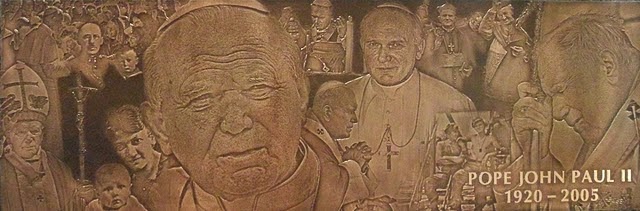
At his funeral in St. Peter's Square in 2005, there were prolonged chants from the multitude gathered for “Santo Subito” (Sainthood Now!). On April 27, 2014, the Catholic Church celebrated the canonization of the 264th pontiff Pope St. John Paul II (born Karol Józef Wojtyła) along with the 262nd Vicar of Christ Pope St. John XXIII (ne Angelo Giuseppe Roncalli) in St. Peter's Square in Vatican City.
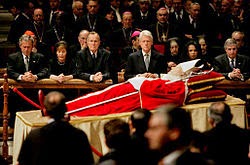 |
| Three American Presidents paying respects to Pope John Paul II, April 2005 |
Some Protestants bristle at the notion that the Church “makes” saints, as nobody (but Christ) is perfect and that we are all supposed to be called to sainthood in our Christian identity. Certainly our baptism marks us as part of the Lord’s people and calls us to holiness. The Catholic Church can recognize, based on investigation and guidance from the Holy Spirit, that a person is already a saint, definitely in heaven and having led a life of great holiness that is worthy of veneration by the faithful. Canonized
saints are important examples to the faithful of how to live a heroic (not perfect) Christian life.
Pope John Paul II was a remarkable man who wore many hats in his life. He was a Laborer, Thespian, Playwright, Patriot, Priest, Philologist, Philosopher, Pilgrim, Bishop, Theologian, Sportsman, Scholar, Statesman and Vicar of Christ. The cause for John Paul II's canonization however is not premised on doctrinal dissertations, academic accolades or even geopolitical accomplishments.
It is about how John Paul II lived his life to reflect the Christian virtue which still touches the faithful today.
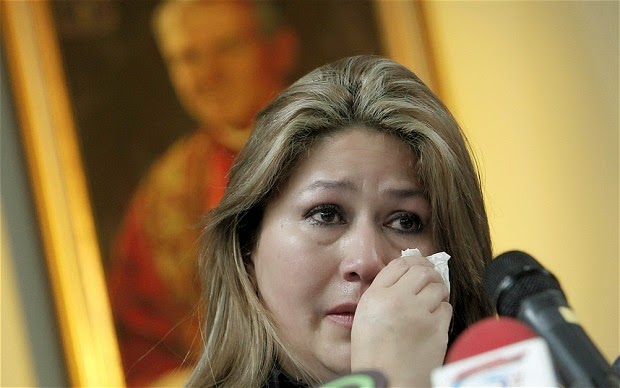
After several years of investigation led by postulator Monsignor Slawomir Oder, the Vatican’s Congregation for the Causes of Saints recommended Servant of God John Paul II’s heroic virtue to the Pope. On December 19, 2009, Pope Benedict XVI proclaimed John Paul II as “Venerable”. The Church normally requires that one miracle is attributable to intercessions of a Venerable, but the Vatican only investigates possible miracles after a candidate is declared Venerable. These miracles are almost always miraculous medical cures as these are the easiest to verify.
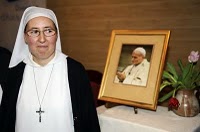 |
| Sr. Marie Simon Pierre |
[***]
 |
| Floribeth Mora Diaz |
[***]
The date of the canonization may well have been chosen because it was the 2nd Sunday of Easter, which Pope John Paul II instituted during his Papacy as “Divine Mercy Sunday”, due to his Devotion to St. Faustina Kowalska (1905-1938). The vigil mass of the feast of Divine Mercy had just been celebrated at John Paul II’s bedside when he fell into a coma and soon after died.
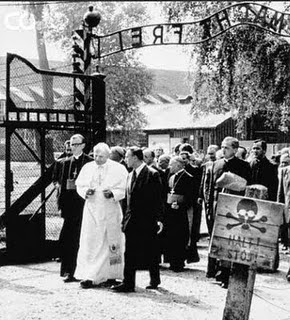 |
| Pope John Paul II at Auschwitz (1979) |
[***]
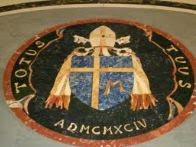 Then Cardinal Karol Wojtyła was elected Pontiff in October 1977 during the Year of Three Popes. While Pope John Paul II was the first non-Italian pope in 454 years and was from a nation behind the Iron Curtain, he was chosen because of his theology. John Paul II chose as his papal motto “Totus Tuus”, which reflected his Reflected his personal consecration to Mary which was based on the spiritual approach of St. Louis de Montfort (1673-1716)—“Totus
tuus ego sum, et omnia mea tua sunt" ("I am all yours, and all that I have is yours"). In Crossing the Threshold of Hope, he explained that the “Totus Tuus” motto expressed the understanding that he “[c]ould not exclude the Lord's Mother from my life without neglecting the will of God-Trinity”. Polish born composer Henryk Gorecki (1933-2010) wrote the choral
piece “TotusTuus” in honor of Pope John Paul II’s 3rd visit to Poland in 1987.
Then Cardinal Karol Wojtyła was elected Pontiff in October 1977 during the Year of Three Popes. While Pope John Paul II was the first non-Italian pope in 454 years and was from a nation behind the Iron Curtain, he was chosen because of his theology. John Paul II chose as his papal motto “Totus Tuus”, which reflected his Reflected his personal consecration to Mary which was based on the spiritual approach of St. Louis de Montfort (1673-1716)—“Totus
tuus ego sum, et omnia mea tua sunt" ("I am all yours, and all that I have is yours"). In Crossing the Threshold of Hope, he explained that the “Totus Tuus” motto expressed the understanding that he “[c]ould not exclude the Lord's Mother from my life without neglecting the will of God-Trinity”. Polish born composer Henryk Gorecki (1933-2010) wrote the choral
piece “TotusTuus” in honor of Pope John Paul II’s 3rd visit to Poland in 1987.
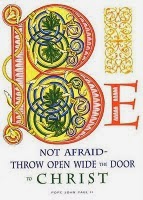
From the start of his Petrine ministry until his eventual death from Parkinson’s Disease 26 ½ years later, John Paul II’s message to the faithful was the Lucan exhortation “Be not afraid”. In fact, John Paul II uttered the phrase three times during his homily at the Papal Inauguration. This message “Be not afraid… open the door wide to Christ” was chosen as the slogan for his beatification.
It was the same message that he brought when he first visited his homeland of Poland in June 1979. The documentary Nine Days That Changed the World showed the power that John Paul II message of “Be not afraid” had with the Polish people to instill the dignity of the individual to live out their faith and, with the guidance of the Holy Spirit, renew the face of the Earth and their land.
It was the same message that he brought when he first visited his homeland of Poland in June 1979. The documentary Nine Days That Changed the World showed the power that John Paul II message of “Be not afraid” had with the Polish people to instill the dignity of the individual to live out their faith and, with the guidance of the Holy Spirit, renew the face of the Earth and their land.
 The millions of Poles who flocked to their favorite son's first pilgrimage back to his homeland showed that the faithful were not alone in that officially atheistic state and served as a real retort to Stalin’s taunt of “The Pope! How man divisions does he got?" Both Lech Walesa, the piously Catholic worker who lead
the Solidarity movement (and eventually became Poland’s President), and Vaclav Havel, the less spiritual leader of a free Czechoslovakia, credit the fall of the Iron Curtain to the message “Be not afraid” embodied in John Paul II’s 1st visit to Poland.
The millions of Poles who flocked to their favorite son's first pilgrimage back to his homeland showed that the faithful were not alone in that officially atheistic state and served as a real retort to Stalin’s taunt of “The Pope! How man divisions does he got?" Both Lech Walesa, the piously Catholic worker who lead
the Solidarity movement (and eventually became Poland’s President), and Vaclav Havel, the less spiritual leader of a free Czechoslovakia, credit the fall of the Iron Curtain to the message “Be not afraid” embodied in John Paul II’s 1st visit to Poland.
On May 13, 1981, Pope John Paul II was shot four times at close range and critically wounded in St. Peter’s Square by Mehmet Ali Ağca, a trained Turkish gunman. Many belief that this assassination attempt was a hit job coordinated by the Bulgarian
Secret Police with the complicity of the Kremlin. Yet less than two and a half years later, John Paul II met with Mehmet Ali Ağca and forgave the gunman on Christmas, 1983.
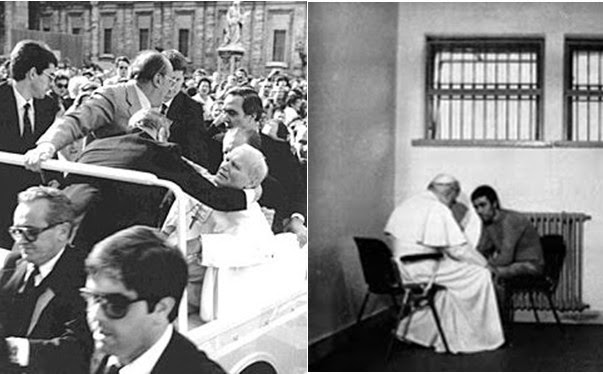 |
| [L] Pope John Paul II shot May 13, 1981, [R] Pope forgives Agca December 25, 1983 |
Pope St . John Paul II was convinced that Our Lady of Fatima kept him alive during the ordeal where he lost 3/4ths of his blood.
The Third Secret of our Lady of Fatima can be seen as predicting the assassination attempt on the Pope. The John Paul II’s
faith filled connection between his assassination attempt and the visions of Fatima that a bullet from his wounds now tops the golden finery of the Our Lady of Fatima processional statue.
One of the hallmarks of Pope St. John Paul II’s reign was being a Pilgrim as Vicar of Christ to proclaim Jesus as the Redeemer of Humanity to all the Earth. Frankly, he came pretty close to covering it all. It is speculated that the curia spent about a fourth of their time planning for and executing his 104 foreign trips to 125 countries which totaled 725,000 miles.
[***]
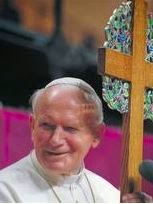 At the behest of Pope St. John Paul II, World Youth Days were held every couple of
years at rotating international locations. Skeptics certainly questioned in
disengaged youth would care about such events, but the youth loved to rally
around the Pope and open themselves to the new evangelization. The
vitality of World Youth Day tradition has not subsided in the loss of
John Paul II. These large conclaves of young people meeting to renew
their faithful inclinations echoes how John Paul II loved to channel the energy
of crowds in a positive manner to allow people to feel connected in a vibrant
and visceral way.
At the behest of Pope St. John Paul II, World Youth Days were held every couple of
years at rotating international locations. Skeptics certainly questioned in
disengaged youth would care about such events, but the youth loved to rally
around the Pope and open themselves to the new evangelization. The
vitality of World Youth Day tradition has not subsided in the loss of
John Paul II. These large conclaves of young people meeting to renew
their faithful inclinations echoes how John Paul II loved to channel the energy
of crowds in a positive manner to allow people to feel connected in a vibrant
and visceral way.[***]
While Pope Benedict XVI did not formally recognize John Paul II as a martyr in his
beatification mass, many feel that the manner in which John Paul II lived with his debilitating disease and how he died with dignity in the Vatican was exemplary. His final words were uttered in Polish "Allow me to depart to the house of the Father". John Paul II had run the good race and was not afraid to go home to the Father by extending his life through extraordinary medical procedures for terminal illness.
In addition, Pope St. John Paul II left a large body of theology during his long pontificate, which will have a long lasting influence upon the Church. [***] Many feel that Pope St. John Paul II will be best remembered for his "Theology of the Body", which was based on 129 lectures from his Wednesday audiences, which focused on Christian marriage, celibacy and virginity, contraception and the sacrament of marriage.
In Washington, DC, the new seminary has dedicated to the now Pope St. John Paul II. The John Paul II Cultural Center in Washington DC has been converted into a Church and Shrine and will be rechristened the "St. John Paul II Shrine".
Pope St. John Paul II's example of the new evangelization, his example of forgiveness and fearlessness for standing up for the faith certainly gives the model to “Be Not Afraid” in our own paths toward being part of the Community of Saints.
 SEE MORE at DC-LausDeo.US