Showing posts with label Video. Show all posts

Monday, July 21, 2014

A Bit On ISIS Marking Christians for Extermination and Expropriation in Iraq


As jihadist Sunni Islamist terrorists from ISIS/ISIL strive to create a sharia inspired Caliphate as they take over territory in Iraq and Syria, they are slaughtering innocent Christians.  


However, even sharia law allows for dhimmitude, second class citizen status for "people of the book" (i.e. Jews and Christians) so long as they pay the jizya tax.  But that is not good enough for ISIS jihadists.  They have taken to mark the buildings of Christian institutions with spray-painted red marks indicating holdouts to exterminate and expropriate.


Spraypainted ISIS Extermination Graffiti on Christian buildings in Mosel, Iraq
"Nun" 14th letter in Arabic alphabet
 The symbol is "Nun", the 14th letter in the Arabic alphabet.  It is the first letter in the name "Nazara" (or Nazarenes) the way in which Muslims have referred to Christians since the 7th Century. This is intended as a badge of shame for what is perceived as a contemptible and disobedient sect. 

SEE MORE at DC-LausDeo.US 


Friday, April 25, 2014

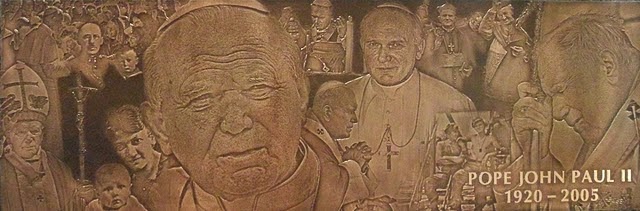
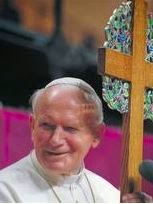
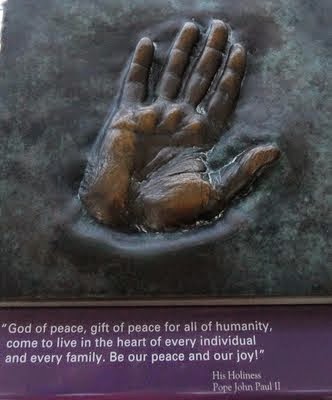
Some Consideration of the Heroic Virtues of Pope St. John Paul II


At his funeral in St. Peter's Square in 2005, there were prolonged chants from the multitude gathered for “Santo Subito” (Sainthood Now!).  On April 27, 2014, the Catholic Church  celebrated the canonization of the 264th pontiff Pope St. John Paul II (born Karol Józef Wojtyła) along with the 262nd Vicar of Christ Pope St. John XXIII (ne Angelo Giuseppe Roncalli) in St. Peter's Square in Vatican City.


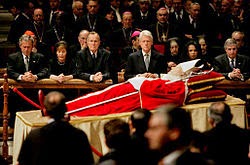
Three American Presidents paying respects to Pope John Paul II, April 2005
 
Some Protestants bristle at the notion that the Church “makes” saints, as nobody (but Christ) is perfect and that we are all supposed to be called to sainthood in our Christian identity.  Certainly our baptism marks us as part of the Lord’s people and calls us to holiness.  The Catholic Church can recognize, based on investigation and guidance from the Holy Spirit,  that a person is already a saint, definitely in heaven and having led a life of great holiness that is worthy of veneration by the faithful.  Canonized saints are important examples to the faithful of how to live a heroic (not perfect) Christian life.

Pope John Paul II was a remarkable man who wore many hats in his life. He was a Laborer, Thespian, Playwright, Patriot, Priest,  Philologist, Philosopher, Pilgrim, Bishop, Theologian, Sportsman, Scholar, Statesman and Vicar of Christ.  The cause for John Paul II's canonization however  is not premised on doctrinal dissertations, academic accolades or even geopolitical accomplishments. It is about how John Paul II lived his life to reflect the Christian virtue which still touches the faithful today.

After several years of investigation led by postulator Monsignor Slawomir Oder, the Vatican’s Congregation for the Causes of Saints recommended Servant of God John Paul II’s heroic virtue to the Pope. On December 19, 2009, Pope Benedict XVI proclaimed John Paul II as “Venerable”.  The Church normally requires that one miracle is attributable to intercessions of a Venerable, but the Vatican only investigates possible miracles after a candidate is declared Venerable. These miracles are almost always miraculous medical cures as these are the easiest to verify.

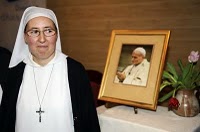
Sr. Marie Simon Pierre
Sister Marie Simon Pierre, a nun from the order of Little Sisters of the Catholic Motherhood in Aix au Province, France, had suffered with Parkinson’s Disease, like John Paul II, for four years. She intensely prayed along with her community for healing through the intercession of John Paul II only two months after John Paul II’s death.  Doctors determined that Sr. Simon Pierre’s neurological symptoms had disappeared inexplicably.   This was deemed John Paul II's first miracle in 2011. 

[***]

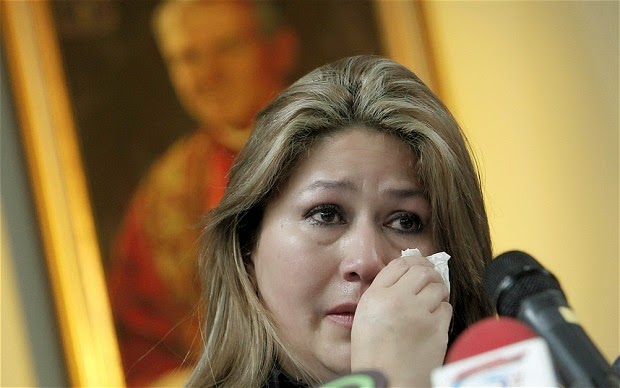
Floribeth Mora Diaz
In April 2011, Floribeth Mora, a 50 year old Costa Rican grandmother, was diagnosed with an inoperable brain aneurysm  and was sent home to die.  But on the day of John Paul II's beatification, Mora saw a photograph of John Paul II and the photograph spoke to her saying "Get up" and "Be not afraid".  Remarkably, her aneurysm disappeared that same day. Neuro-surgeons in Rome could not medically explain the disappearance.  This miracle satisfied the Congregation for the Causes of Saints in the Vatican.

 [***]

The date of the canonization may well have been chosen because it was the 2nd Sunday of Easter, which Pope John Paul II instituted during his Papacy as “Divine Mercy Sunday”, due to his Devotion to St. Faustina Kowalska (1905-1938).  The vigil mass of the feast of Divine Mercy had just been celebrated at John Paul II’s bedside when he fell into a coma and soon after died.

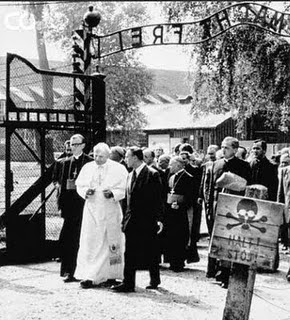
Pope John Paul II at Auschwitz (1979)
The date of John Paul II’s canonization also occurs on National Holocaust Rememberance Day in Israel and during the March of the Living where people  gather in in  Krakow,  Wojtyła’s home for 40 years, to march between the Nazi death camps of  Auschwitz to Birkenau to remember the Holocaust.  John Paul II had strong connections with the Jewish community in his childhood home off Wadowice, where ¼  of the town’s 8,000 residents were eradicated for anti-Semitic aspirations of Nazi racial purity.  These events strongly influenced John Paul II’s weltanschauung, since during his pontificate, John Paul II made great strives to acknowledge the sin of anti-semitism, especially in the Holocaust, and to strengthen the Church’s relations with the Jewish Community. In May 1998, Pope St. John Paul II gave a formal apology about Catholic shortcomings in the Holocaust in the proclamation "We Remember: A Reflection of the Shoah".
   
[***]

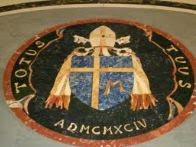
Then Cardinal Karol Wojtyła was elected Pontiff in October 1977 during the Year of Three Popes.  While Pope John Paul II was the first non-Italian pope in 454 years and was from a nation behind the Iron Curtain, he was chosen because of his theology.  John Paul II chose as his papal motto “Totus Tuus”, which reflected his Reflected his personal consecration to Mary which was based on the spiritual approach of St. Louis de Montfort (1673-1716)—“Totus tuus ego sum, et omnia mea tua sunt" ("I am all yours, and all that I have is yours").  In Crossing the Threshold of Hope,  he explained that the “Totus Tuus” motto expressed the understanding that he “[c]ould not exclude the Lord's Mother from my life without neglecting the will of God-Trinity”.  Polish born composer Henryk Gorecki (1933-2010) wrote the choral piece “TotusTuus” in honor of Pope John Paul II’s 3rd visit to Poland in 1987.

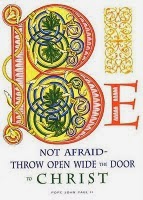
From the start of his Petrine ministry until his eventual death from Parkinson’s Disease 26 ½ years later, John Paul II’s message to the faithful was the Lucan exhortation “Be not afraid”.   In fact, John Paul II uttered the phrase three times during his homily at the Papal Inauguration.  This message “Be not afraid… open the door wide to Christ” was chosen as the slogan for his beatification.  


  It was the same message that he brought when he first visited his homeland of Poland in June 1979.  The documentary Nine Days That Changed the World showed the power that John Paul II message of “Be not afraid” had with the Polish people to instill the dignity of the individual to live out their faith and, with the guidance of the Holy Spirit, renew the face of the Earth and their land.

The  millions of Poles who flocked to their favorite son's first pilgrimage back to his homeland showed that the faithful were not alone in that officially atheistic state and served as a real retort to Stalin’s taunt of “The Pope! How man divisions does he got?"  Both Lech Walesa, the piously Catholic worker who lead the Solidarity movement (and eventually became Poland’s President), and Vaclav Havel, the less spiritual leader of a free Czechoslovakia, credit the fall of the Iron Curtain to the message “Be not afraid” embodied in John Paul II’s 1st visit to Poland. 


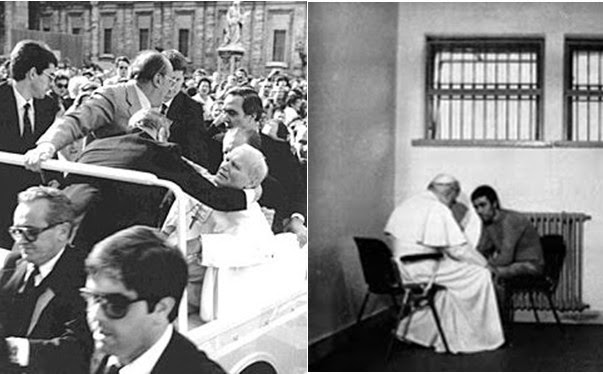
On May 13, 1981, Pope John Paul II was shot  four times at close range and critically wounded in St. Peter’s Square by Mehmet Ali Ağca, a trained Turkish gunman. Many belief that this assassination attempt was a hit job coordinated by the Bulgarian Secret Police with the complicity of the Kremlin.  Yet less than two and a half years later, John Paul II met with Mehmet Ali Ağca and forgave the gunman on Christmas, 1983.


[L] Pope John Paul II shot May 13, 1981, [R] Pope forgives Agca December 25, 1983
 
Pope St . John Paul II was convinced that Our Lady of Fatima kept him alive during the ordeal where he lost 3/4ths of his blood. The Third Secret of our Lady of Fatima can be seen as predicting the assassination attempt on the Pope. The John Paul II’s faith filled connection between his assassination attempt and the visions of Fatima that a bullet from his wounds now tops the golden finery of the Our Lady of Fatima processional statue. 
  
One of the hallmarks of Pope St. John Paul II’s reign was being a Pilgrim as Vicar of Christ to proclaim Jesus as the Redeemer of Humanity to all the Earth. Frankly, he came pretty close to covering it all.  It is speculated that the curia spent about a fourth of their time planning for and executing his 104 foreign trips to 125 countries which totaled 725,000 miles.  

[***]

At the behest of Pope St. John Paul II, World Youth Days were held every couple of years at rotating international locations. Skeptics certainly questioned in disengaged youth would care about such events, but the youth loved to rally around the Pope and open themselves to the new evangelization.  The vitality of  World Youth Day tradition has not subsided in the loss of John Paul II.  These large conclaves of young people meeting to renew their faithful inclinations echoes how John Paul II loved to channel the energy of crowds in a positive manner to allow people to feel connected in a vibrant and visceral way.

[***]


While Pope Benedict XVI did not formally recognize John Paul II as a martyr in his beatification mass, many feel that the manner in which John Paul II lived with his debilitating disease and how he died with dignity in the Vatican was exemplary.  His final words were uttered in Polish "Allow me to depart to the house of the Father".  John Paul II had run the good race and was not afraid to go home to the Father by extending his life through extraordinary medical procedures for terminal illness.

In addition, Pope St. John Paul II left a large body of theology during his long pontificate, which will have a long lasting influence upon the Church.  [***]  Many feel that Pope St. John Paul II will be best remembered for his "Theology of the Body", which was based on 129 lectures from his Wednesday audiences, which focused on Christian marriage, celibacy and virginity, contraception and the sacrament of marriage. 

In  Washington, DC, the new seminary  has dedicated to the now Pope St. John Paul II. The John Paul II Cultural Center in Washington DC has been converted into a Church and Shrine and will be rechristened the "St. John Paul II Shrine".

Pope St. John Paul II's example of the new evangelization, his example of forgiveness and fearlessness for standing up for the faith certainly gives the model to “Be Not Afraid” in our own paths toward being part of the Community of Saints.


 SEE MORE at DC-LausDeo.US

Thursday, April 10, 2014

Pope Francis Condemns Slaying of Dutch Jesuit in Syria


Dutch Jesuit Fr. Francis van der Lugt was brutally murdered in Homs, Syria by masked gunman. The septigenarian cleric was beaten by a masked man on the street in front of the Jesuit monastery in Bustan al-Diwan, a Christian portion of the Old City,  and then he was shot twice in the head.

Fr. van der Lugt who was a trained psychotherapist, had spent fifty years living in Syria ministering to disabled people at the Al Ard Center near Homs.  The Center also took in refugees from the Syrian Civil War, but that mission curtailed as the staff fled since they could not ensure the safety of their guests.  Fr. van der Lugt tried to be a companion to those in mental distress and give them as much food as possible.

Fr. Frans refused to be part of the February 2014 UN supervised evacuation of 1,400 people from the city, which had been besieged for a year and a half.  In the Old City of Homs, the Christian population had shrunk from tens of thousands to just 66.  Christians used to make up 10% of the Syrian population before the Civil War, but Christians have been brutalized for their faith during the conflict Fr. van der Lugt reasoned that he was the only priest remaining to minister to his people so how could he leave.

In January, Fr. van der Lugt made pleas through the media that gained world-wide attention to have humanitarian aid sent to the city to feed the starving Muslim and Christian population.


This led to meeting with UN officials to receive aid and hear first hand accounts of the humanitarian trials in Homs. Fr. van der Lugt procured four kilos of kilos of flour a week from a Muslim charity so that he could make bread and distribute half a loaf to the enclaves neediest 30 people.

[***]

Fr. van der Lugt's selfless dedication to his fellow man and openness to serve the Lord even unto death
echos the ultimate sacrifice that our Lord Jesus Christ which we will celebrate next week in the Triduum.

SEE MORE at DC-LausDeo.US


Friday, January 24, 2014

Honoring St. Francis de Sales, the Patron Saint of Writers


Today is the feast day of St. Francis de Sales (1567-1622).  Francis de Sales was canonized in 1665.  St. Francis de Sales was known both for his medium as well as his message.  St. Francis de Sales was named a doctor of the Church by Pope Blessed Pius IX in 1877 for works like "An Introduction to a Devout Life".   

In 1924, Pope Pius XII  proclaimed St. Francis de Sales the patron saint of writers and journalists (and now bloggers) since he extensively used media (flyers and books in his spiritual direction and his apologetics to convert Calvinists in the region.   During his missionary work in Switzerland, Francis de Sales was able to help up to 70,000 people return to the faith.  Aside from his prolific wring, St. Francis de Sales was known for his concern for writing with truth and charity.  Hence, he is also considered a patron for Christian Unity. 


 Through your prayers, St. Francis de Sales, I ask for your intercession as I attempt to bring the written word to the world. Let us pray that God takes me in the palm of His hand and inspires my creativity and inspires my success. St. Francis de Sales, you understand the dedication required in this profession. Pray for God to inspire and allow ideas to flow. In His name, let my words reflect my faith for others to read. Amen.

Wednesday, December 4, 2013

Appreciating Advent Through Art for the First Week on Advent

Detail of Michelangelo's Sistine Chapel (1512)


Today is the start of the new liturgical year for the Roman Catholic Church. It also marks the first Sunday of Advent for the Latin Church (other Eastern Churches started a fortnight beforehand). In our secular society, we can be tricked into thinking that the Advent calendar is only a countdown for Christmas shopping.  But scripture during Advent reminds us of the dual nature of the season:  to prepare for the cyclical celebration of Our Lord's birth as well as Parousia (the Second Coming). 

The Lectionary during Cycle A features Isaiah's prophetic vision (IS 2:1-5) when God reigns Supreme and swords are hammered into plowshares and spears into pruning hooks. Daniella Zsupan-Jerome, a professor of liturgy at Loyola University in New Orleans, uses a detail of Michelangelo's Sistine Chapel to illustrate the scripture.  


The Gospel (MT 24:37-44) alludes to the Second Coming where Jesus exhorts the faithful to be prepared as Noah was for the Flood.  This is sobering "Good News" but it should help lead us with our walk with the Lord, especially in this period of preparation.  

The Isaiah panel on the Sistine Chapel prompts a ponderous thought. Zsupan-Jerome wondered if position of Noah's Ark about Isaiah prompted the prophet to think  of Mount Ararat, where Noah's Ark landed, as he handed the vision of God's Holy Mountain? This would lend the aspiration that man should seek God's holy mountain to, borrowing a phrase from the Responsorial Psalm (PS 122), "dwell in the House of the Lord."

The Noahide Covenant established that the Lord would not destroy humanity through a flood. The Messiah's admonition to be prepared has some soothing subtexts rather than relying upon our own inadequate righteousness. The name Jesus can be translated to "Yahweh Saves".  Moreover, the Lord so loved the world, He sent His only son to be born of this world in all things but sin and be an intregal part of our salvific history. 

As we come into this season of  devout and joyful expectation, it would behoove us to consider the nuances, hermaneutics and deeper meanings of Advent, as expressed through art, scripture and the easily overlooked holiday trappings.  

h/t:  Loyola Press 

Wednesday, November 13, 2013

USCCB Reaffirms Steadfast Commitment to Religious Liberty


As the U.S. Council of Catholic Bishops concluded their semi-annual meeting in Baltimore, the USCCB issued a special message on the H.H.S. Mandate.  The Bishops have been steadfast and vocal in their opposition to having the government force Catholics and other believers to violate their religious precepts in the pursuit of universal coverage. 

During his tenure as President of the USCCB, New York Archbishop Timothy Cardinal Dolan lead the faithful to conduct Fortnight for Freedom in 2012 and 2013 to celebrate, educate and advocate maintaining America's Fundamental Freedom--the First Amendment freedom: the freedom of exercise of religion.

As Cardinal Dolan passed the helm of the USCCB to Louisville Archbishop Joseph Kurtz,  Dolan urged his brother bishops to make the protection of religious liberty around the world a priority as he believes that it is a central social issue of our times. Dolan recalled the words of Pope Blessed John Paul II that we are living in a new age of martyrs.  Dolan stated:

We as bishops, as shepherds of one of the most richly blessed communities of faith on the planet, as pastors who have spoken with enthusiastic unity in defense of our own religious freedom, must become advocates and champions for these Christians whose lives literally hang in the balance, as we dare not allow our laudable battles over religious freedom at home to obscure the actual violence being inflicted on Christians elsewhere.


It seems incredible that the USCCB needs to again issue such a pronouncement, but useful idiots arguing for Obamacare are still convicted that Catholics just want to push their beliefs on non-Catholics, rather than protection that unalienable right.


The USCCB's special message fleshed out this fidelity to religious freedom to practice one's faith in America.

Tuesday, October 15, 2013

A Brief Book Review of 10 Answers for Atheists by Alex McFarland


Alex McFarland, an Evangelical Protestant professor of Christian Apologetics at North Greenville University (South Carolina), has authored 10 Answers for Atheists (Regal, 2012) as an outreach tool to spread the Good News to atheists and agnostics


 [***]


Alex McFarland
The tone of McFarland’s prose was conversational with some sprinklings of erudition which reflects the author’s academic auspices.  For example, when McFarland described the scientific atheist, he alluded to “directed panspermia” as an out of this world explanation of our origins.  Moreover,  Jim Morrison of The Doors was alleged to be an “Antinomian Atheist”.  

These pop references do not always work.  To illustrate a “Biblical Scholar Atheist”, McFarland posits Penn Jillette as he rejects scripture as “B.S.”.  This Bible Scholar Atheist label on Jillette seems like a bad trick for one who does not ascribe to Judeo-Christian scripture.  

[***]

McFarland categorized atheists into ten subgroups.  There seemed to be overlap between some of the groups, like the Angry Atheist and the Injured Atheist.  The University of Tennessee study which was Assessing Atheist Archtypes with six categories seemed more on the mark.  However, McFarland may have included other categories to finesse the apologetic approach. 

McFarland offered a clear yet concise historical survey of disbelief which provides an underlying basis for agnosticism and atheism from Antiquity and the Enlightenment to present day.  

[***]

It was surprising that “Roman” Catholics and the Orthodox were not condemned along with modern Mystical spiritualism, as those original Christian creeds used their mysticism to draw closer to union with God. The crux of the Protestant Reformation was religiosity based on biblical roots (often understood as sola scriptura) as well as the primacy of a salvation by grace.  But McFarland does not divide with Catholics or Orthodox Christians on this score in the spiritual warfare against atheism. 

[***]

McFarland poses the ten questions by atheists:


  • Are faith and reason really compatable? 
  • Isn’t belief in God delusional? 
  • The dysteleological surd – If God is so good, why is there evil in the world?
  • Why join a flawed faith like Christianity which has harmed the world? 
  • Isn’t Christianity just mythological? 
  • Why believe in Zombies (a messiah resurrected from the dead)? 
  • Can’t science explain everything?
  • Why believe hypocritical Christians? 
  • Couldn’t Jesus just be a space alien?


His answers plant the seeds for useful apologetics as well as the thirty common objections included in the index.

As a Catholic, I am mindful that the practice of my faith differs with a more evangelical expression of faith by  bible based Protestants.  However, the 10 Answers for Atheists has some material which would provide some thoughtful responses when dialoguing with questioning agnostics and atheists.   Some of the book seemed extraneous to inter-(non) faith dialogue, such as the comparative religion section.  McFarland seemed compelled to justify bible based Christianity before delving into agnostic apologetics.

 Aside from the Angry Atheist and the Resident Contrarian Atheist, McFarland’s 10 Answers for Atheists could serve as a useful field manual for believers beginning dialogue with non-believers.  It does not seem geared at convincing atheists through a casual perusal.  The casual Dawkins, Hitchens and Harris dismissals would be insufficient for true non-believers.  Moreover, an agnostic or atheist reader would need to drudge through comparative religion and justifying bible based Christianity sections before getting to the crux of the answers for atheists.

SEE MORE at DCBarroco.com

Thursday, September 5, 2013

Harvesting Pope Francis's Call for Peace In Syria


Italian artist Dario Gambarin took six hours to plow the likeness of Pope Francis in his parents field in Castargnaro, Italy.


The artist chose Pope Francis as a subject as Mr. Gambarin was inspired by the Pontiff's call for a worldwide day of prayer and fasting for peace in Syria on September 7th. 


Field Artist Dario Gambarin 
Gambarin relies on his innate sense of proportion and his tractor driving capabilities to create his field art.   The image can only really be appreciated when flying near Verona. 

This type of art is deleted after a few days so the field can be cultivated for the new sowing of seed. 

May this act of artisinal agriculture remind us that "Love Liberates" as the world prays for peace in Syria. 

h/t: The Telegraph

[originally posted on DC-LausDeo.US]

Wednesday, July 24, 2013

Ignatian Discernment Found In Homeboy Industries

One of the important charisms that St. Igantius of Loyola brought through his spiritual insights is the notion of finding God in all  things.  In anticipation of the founder of the Society of Jesus' feast day, the website Find Your Inner Iggy is s running a series of stories about finding God in unlikely places.

The text was written by Fr. Greg Boyle, S.J. who discerned his spiritual mission working with the poor and outcast in Los Angeles.  The language may be earthy but by keeping it real, it demonstrates the miracle of finding God in unlikely places.


Louie finished his 18-month training program with us at Homeboy Industries. A gang member and drug dealer, he was tattooed and had a long prison record.

"I was disguised as that guy," he told me once.

He was now thriving in the new job we found him. He texted me one day: “My little fridge just died. Can you help me get a new one?” I text back: “Sears at 4:00.” He responds: “Got it. Beers at 4:00.” When I arrive at the Sears Appliance section, Louie spots me, gallops over, and gives me a bear hug. “Have they called security on your ass yet?’ “Nope,” he says, “but it’s just a matter of time.” We buy a small refrigerator on lay-away, and I drive him to his small, humble apartment.

Before he gets out, he says, “Can I tell you something, G?” He pauses. “Lately... I’ve been havin’ a lot a’ one-on-ones … you know… with God. And ... the Dude shows up.”

I chuckle a little, but he is quite serious. He turns to me, “Now why would he do that?” His tears make a get-away, and he can barely speak. “I mean ... after all the shit I’ve done ... why would He do that?

While it is good that Louie is getting some one-on-ones with the Divine Dude, he missed out on a key insight which those who take the 30 day Ignatian silent retreat should learn.  Much like a spiritual drill sergeant, the Ignatian retreat breaks you down by reminding you of your own sin but in the end build you up by emphasizing that God loves our imperfect selves. But appreciating this unconditional love can tattoo the heart  and can draw us to build the kingdom of God. 

Fr. Boyle began Homeboy Industries in 1992 to help parolees and former gang members lead a better life by finding honest work.  Homeboy Industries does mental health counseling, education  tattoo removal,  and employment services. 


In 2011, Fr. Boyle wrote a book Tattoos on the Heart: The Power of Boundless Compassion (2011) in which the ghetto Jesuit distilled twenty years of his experience into faith filled parables centering on how we could live full lives if we could find the joy of loving others and in being loved unconditionally. 

It is amazing where we can find the divine if we only look lovingly.

Thursday, May 2, 2013

National Day of Prayer -- Praying for Amrerica


For the last 62 years, the first Thursday in May has marked the National Day of Prayer Observance designated by Congress when people are asked to turn to God in prayer and Meditation. With the help of 30,000 volunteers, there are tens of thousands of events held across the country to turn our attention to the eternal.

 The theme for the 2013 National Day of Prayer is “Praying for America”. The organizers for the National Day of Prayer have suggested several techniques to raise our prayers to heaven. Keeping with the Praying for America theme, it is suggested that prayerful people follow a 7x7 prayer for Americas seven centers of power seven times a week. Namely, Americans are encouraged to pray for: 1) the government; 2) the military; 3) the media; 4) business; 5) education; 6) church and 7) the family.


Father, we come to You to pray for our nation, the United States of America.      
How You have blessed us through the years, Lord! We rightly sing, “America, America, God shed His grace on thee.” Yet we see trouble in our culture today. We see the breakdown of the family, crippling addictions, and random acts of horrific violence.

Lord, we need Your help in America. In recent days, we have done our best to remove Your Word and Your counsel from our courtrooms, classrooms and culture. It seems, as President Lincoln once said, that we have “forgotten God.” But Lord, You have not forgotten us! You can bless and help and revive our country again.
Scripture tells us that “Righteousness exalts a nation, but sin is a reproach to any people” (Proverbs14:34). Lord, in Your mercy, we ask that You would exalt our country again. We have had a number of great awakenings in America. We have experienced times of refreshing, and revivals that changed not only the spiritual but also the moral landscape. As the psalmist said, “Will You not revive us again, so that Your people may rejoice in You?” (Psalm 85:6)

That is our prayer for America today, Lord. Send a mighty spiritual awakening that will turn the hearts of men and women, boys and girls back to you. You have told us if we will humble ourselves and pray, and seek Your face and turn from our wicked ways, that You will forgive our sins and heal our land. (2 Chronicles7:14)

Forgive us today, Lord, and heal this troubled land that we love so much.


We ask all of this in the name of Jesus Christ.


But May 2nd is only the beginning of the ministry to Pray for America. During Memorial Day weekend, the organizers will launch the first Pray for America Rally Tour, with a specially decked out bus to promote fervent prayer in the communities where they will visit.


As an outreach to social media, the organizers of the National Day of Prayer are highlighting a video by Santus Real "Pray".


In trying times like this, we need all the prayer that we can get.

h/t:  National Day of Prayer
      Pray for America

Sunday, March 31, 2013

Maronite Easter Vigil


At Our Lady of Lebanon Maronite Catholic Church in Shepherd's Park (Washington, DC)  the Easter Vigil begins at midnight.


 The interior of the church reflects the austere monastic sensibilities of St. Maroun, the 5th Century Syriac  monk  who shaped this Syriac-Antiochian rite Catholic Church that profoundly influenced Lebanon.


Prior to the accent lights being turned on, the design was stark and aesthetically challenging for me.  Even with the lights on, the altar is surprisingly barren for the most important feast of the liturgical year for Christians.  There were a few lillies at the foot of the main altar and there was a floral display on the East Apse which also served as the Empty Tomb for the Easter Vigil. Note the tree stump at the foot of the altar, that is used as a stand for the veneration of the Cross.  Perhaps it harkens back to the Cedars of Lebanon, which is an important symbol amongst Maronite Catholics.


This is the Clergy approaching the altar for the beginning of the Qurbono (Divine Liturgy).  Note the Chorbishop in the center who's vestment has a cross with the Cedar of Lebanon. The Liturgy was conducted in Syriac as well as English.  The hymns that were sung were in Aramaic which was impossible for me to read.  Aramaic was Jesus' native tongue so it sounded like what  the followers of "The Way" would have sung in the 1st Century A.D.


There were some unusual aspects of this Easter Vigil.  There was incense but no use of Holy Water or candles.  The Maronite Church tends to baptize their Catachumens on the Feast of the Epiphany in January.  Candles are not as import of an symbol at the Easter Vigil, as the Maronite Church breaks fast on noon of Great Saturday during the simple "Awaited Light" ceremony.  This may explain why there is not pent up anticipation for the Easter Vigil as observed amongst the Maronites.

 It was remarkable how much this Liturgy celebrating the Resurrection emphasized the Glorious Cross.  The Chorbishop made prayers on the four corners of the altar with the processional cross, as if to proclaim the hope of the resurrection to all the Earth.  The faithful were invited to venerate the Glorified Cross as they received Communion. Another interesting Easter feature of this vigil Qurbono was the emphasis on the Empty Tomb.  As the faithful departed from the Divine Liturgy, they were given flowers from the Empty Tomb as well as an Easter Egg.


Despite the alternating languages during the Liturgy, it was not challenging to follow.  The order of the Liturgy is different, as the Prayers of the Faithful are offered in the middle of the Liturgy of the Eucharist.  In addition, the sign of peace is passed along from the altar to the congregation by youthful altar servers. For me, the Maronite Qurbono was the most exotic of my Holy Week experiences.  Unfortunately, I found  the Easter Vigil at Our Lady of Lebanon to be anti-climatic and personally unsatisfying.  That being said, I was intrigued by proclaiming the glory of the cross to the four corners of the Earth. In addition, I was touched by the post resurrection highlighting of the Empty Tomb as well as receiving the Easter souvenirs.

Friday, March 29, 2013

Sound the Strepitus

An Obituary and Eulogistic Meditation of Yeshua bar Yahosef bar Yaqub


The Strepitus is the sudden loud clatter that symbolizes how the Earth convulsed at the physical death of the only begotten Son of our Lord.   In Matthew 27:46-53, when Christ gave up His spirit on the Crucifix, there was a tumultuous earthquake.   It is the jarring closing of a Tenebae Service, which is done in preparation for the Paschal Triduum.


Some churches have the Tenebrae on Spy Wednesday.  Others choose to extinguish the lights after celebrating the Last Supper on Maundy Thursday or even Great and Holy Friday.  Regardless of the time, it is a ritual that reminds us of how the Light of the World was briefly extinguished to fulfill scripture as an expiation for mankind’s sinfulness.

While it is difficult to watch Mel Gibson’s cinematic masterpiece The Passion of the Christ (2004) for its depiction of the savage brutality inflicted by the Roman overlords on a political prisoner who challenged the religious practices and expectations of the Jewish hierachy.   The teardrop from heaven is incredibly moving.


When Salvador Dali painted Christ of Saint John of the Cross (1951), Jesus was depicted without wounds on a Cross that floated above the Earth. Dali listened to the color of his dream that indicated that depicting the nails, blood and crown of thorns would mar the image.  Dali wanted the emphasize the Trinity with the positioning of Jesus hanging on the Cross to represent the nucleus of the atom.  Clearly, the cross hovering over the Earth shows the cosmic significance of the passion and death of our Lord Jesus Christ. In a modern manner, Dali celebrates Eastern Christian Church's emphasis mystagogy of Jesus' Divine Sacrifice by death on the cross.


But during a Tenebrae service, the faithful were reminded that unlike even in classical depictions of Golgatha (the place of the skull) where Jesus was crucified, the crosses of Calvary were not necessarily hung that high in the air.  Since those being executed had their feet nailed bound to prevent them from moving as they slowly suffocated on their crosses, they may have been only a couple of feet above the ground.

Such crosses would serve the Roman overlords as tangible examples of what happens to brigands, rabble rousers and revolutionaries. The low positioning would allow most passers-by to look into the eyes of the executed. This makes the taunts from the crowd and Jesus’ words of forgiveness all the more remarkable.

It is easy to gloss over how the expiation of mans’ sins required a blood sacrifice to seal the New Covenant. By cognitively sounding the Strepitus over Christ's crucifixion, we may "Ecce homo".

While some ears may find it as painful as the Stepitus, the Christ’s Passion has been told by Glenn Beck using a motif of Pink Floyd’s Dark Side of the Moon  (1973).  Whether we use pop parables, cinematic accounts, scriptural studies, communal worship or prayerful personal reflections, it is worthy to reflect on how God's only begotten Son chose to be the suffering servant to right the relationship between God and mankind.

Wednesday, March 27, 2013

Spy Wednesday Tenebrae with the Suspcious Cheese Lords


Mount St. Sepulchre in Washington, DC is a Franciscan Monastery of the Holy Land in America. The Church itself neo-Byzantine design by Roman architect Aristide Leonari in 1899.  The church looks akin to  St. Sophia (Hagia  Sophia) in Constantinople (Istanbul).


The interior of the church resembles a five fold Crusader Cross of Jerusalem. The large bronze baldachin is is supported by columns which depicts the twelve Apostles. The interior is decorated with the Ave Maria and scenes from the life of Mary.

The Friary is the home of Franciscan Commissariat in the nation's capital, and they continue their 800 year tradition of supporting the Holy Land. Part of the charism of the Commissariat seems to be a special celebration of Passiontide.

The Tenebrae service which is celebrated on Spy Wednesday is is resplendent in faith and history, as is incorporates a cappella medieval pieces sung by the Suspicious Cheese Lords (Suscipe Domine Queso).

While they are a consummate choir, the Suspicious Cheese Lords need to practice their polyphonic songs in situ at the Franciscan Monastery.


The Suspicious Cheese Lords in rehearsal for the Tenebrae Service.


Even though the Suspicious Cheese Lords ordinarily sing early music works, one year they chose to perform Arvo Part's De Profundis (1980).


Lighting the Candelabra for the Tenebrae Service.


Extinguishing the candles during the Tenebrae Service.


 The closing of the Tenebrae service is marked by a retreat of the single candle into the crypt.  As the vault to the catacombs is slammed, it sets off an unnerving Strepitus, meant to symbolize the earth convulsing at the death of the the Messiah, Jesus the Christ.

Friday, March 15, 2013

Checking Out Pope Francis


After paying respects to the Salvation of the Roman People icon at the Papal Basilica of Santa Maria Maggiore  (a.k.a. Our Lady of the Snows), Pope Francis' ecclesiastical entourage took an unexpected detour.  

The newly elected Argentine pope asked his driver to circle back to the Domus Internationalis Paulus VI,  so that Pope Francis could collect his luggage.  After he collected his things, the prelate went to the front desk of the Vatican run boarding house to thank the staff.  Then Pope Francis insisted upon paying his bill. 


Most people might have understood had the Pope had.left the Church pick up the 85 Euro a night tab for a complete pension,  he insisted on trying to pay his way to set a good  example of  what priests and bishops should do.  It is unclear how much Pope Francis actually paid. Moreover, it is humorous but dubious that he claimed that he checked in under a different name. 

This pied-de-terre episode certainly solidifies Pope Francis' reputation for frugality and fraternity with common folks.  But it may symbolize some of the new Pontiff's ambitions to challenge the comfortable situations of the Curia and dispel the anti-clerical slight that the Church lives high on the hog on their parishioners' tithes. 

The early trip to Santa Maria Maggiore may also herald another important aspect of Pope Francis's papacy.  New Popes are expected to visit all five of Rome's patriarchal basilicas early in their reign.  Moreover, many recent pontiffs, especially Pope Blessed John Paul II, have major Marian devotions.     
                                                
It is telling, however,  the on the morning of his first full day in the chair of St. Peter that Pope Francis visits  Salus Populi Romani and also brings flowers.  This icon is of particular significance to Romans. For example, when Rome was going to fall from Axis control in World War II, Adolph Hitler vowed to bomb the Eternal City to smithereens.  Pope Pius XII arranged a procession of the Byzantine Salus Populi Romani through the streets and miraculously a fog enveloped the city, so the angry Nazi bombs only fell on a Roman cemetery.  This humble act continues Pope Francis identification with his new Roman Diocese.